


One Year After The Gen Z Protests, Organising in Indonesia Continues Against All Odds

PART 1
By Aleksandra Kalisz
Since last year, the persecution of young organisers, activists, and human rights defenders in Indonesia has intensified. Following the 2025 protests, the Indonesian government began employing threatening tactics against leftist movements, ranging from intimidation and surveillance to actual physical violence. Still, young people do not give up and find new ways to protect their freedoms.
March Assault on a Human Rights Advocate
On the evening of the 12th of March 2026, Andrie Yunus, an activist with KontraS (the Commission for Missing Persons and Victims of Violence), was the target of an acid attack that, according to Tempo, was carried out and planned by a special task force linked to the Indonesian Military’s Strategic Intelligence Agency. Several months later, the human rights defender remains too weak to give interviews. He has been permanently disfigured, has lost sight in his right eye, and is undergoing repeated treatment at a Jakarta hospital. This recent attack, however, is not an isolated incident but part of a growing pattern of targeting young activists and of limiting civil freedoms under the government of President Prabowo Subianto, a former general.
The Escalation Of Repression
Last year, four male activists – dan Khariq Anhar, Syahdan Husein, Delpedro Marhaen (Executive Director of the Lokataru Foundation), and Muzaffar Salim – were accused by Indonesian authorities of inciting people to commit violent acts during the mass protests in August. Several others were arrested for social media posts that called people to join the demonstrations. In addition, there have been reports of digital threats and doxing of young participants by state forces.
On the 15th of August 2025, the Indonesian government announced a housing allowance for legislators (over 7000 per official) while at the same time advancing austerity measures that included cuts to education, healthcare, and public works. Ten days later, protests led by the student movement Gejayan Memanggil erupted in Yogyakarta. Thousands of university and high school students, alongside activists, gathered outside Parliament. They condemned corrupt elites and criticised government policies favouring powerful conglomerates and the military. Although the rallies began peacefully, the demonstrators were met with police violence and arbitrary arrests, including of minors. On the 28th of August, protests intensified and spread across the country after a video of Affan Kurniawan, a 21-year-old delivery driver, being run over by a police Mobile Brigade (Brimob) tactical vehicle circulated on social media. The protests expanded to almost 50 cities, proving that young people will not stand idly by the state’s brutality and reforms that fail to serve the broader population.
Tightening The Control
What has been happening recently in Indonesia is not an isolated event occurring in a vacuum. In 2022, the government passed a new Criminal Code that introduced even more restrictive laws limiting personal freedoms and online free speech. It was previously heavily criticised by many activists and civil society organisations for its intrusive provisions, ranging from criminalising premarital sex and cohabitation outside marriage to banning online insults against the president. Yet it was still implemented, officially taking effect on January 2nd, 2026, opening the door to further surveillance and repression by state forces.
This bill, also known as KUHP, sets out new or strengthened controls on a wide range of actions, from spreading fake news and Marxist-Leninist ideology to offending the president. Moreover, some of the Code’s chapters contain vague terms, such as “the honour and dignity” and “humiliation”, which are open to interpretation. As we have observed around the world, this vague terminology makes the laws easy to manipulate and abuse, since it is up to the government to define them, including “criticism” and even “fake news.”
Even though the state’s control tightens its grip, young people in Indonesia do not give up. On the contrary, the mobilisation during last year’s protests and the everyday organisation of grassroots movements prove that, no matter the brutality and ruthlessness of the fascist forces, civil society will always thrive and find ways to fight back.
The Hope of Young Pirates
The August 2025 uprising became more than just an expression of youth resistance – they gave birth to the symbol of the "Straw Hat" pirate flag from the manga “One Piece”, as a representation of young people resisting current corrupt governments. It appeared not only in Indonesia but also in Nepal, Morocco, and even Madagascar. What was later dubbed “Gen Z protests” by the mainstream media was a powerful reminder of the youth’s strength and the power that they hold.
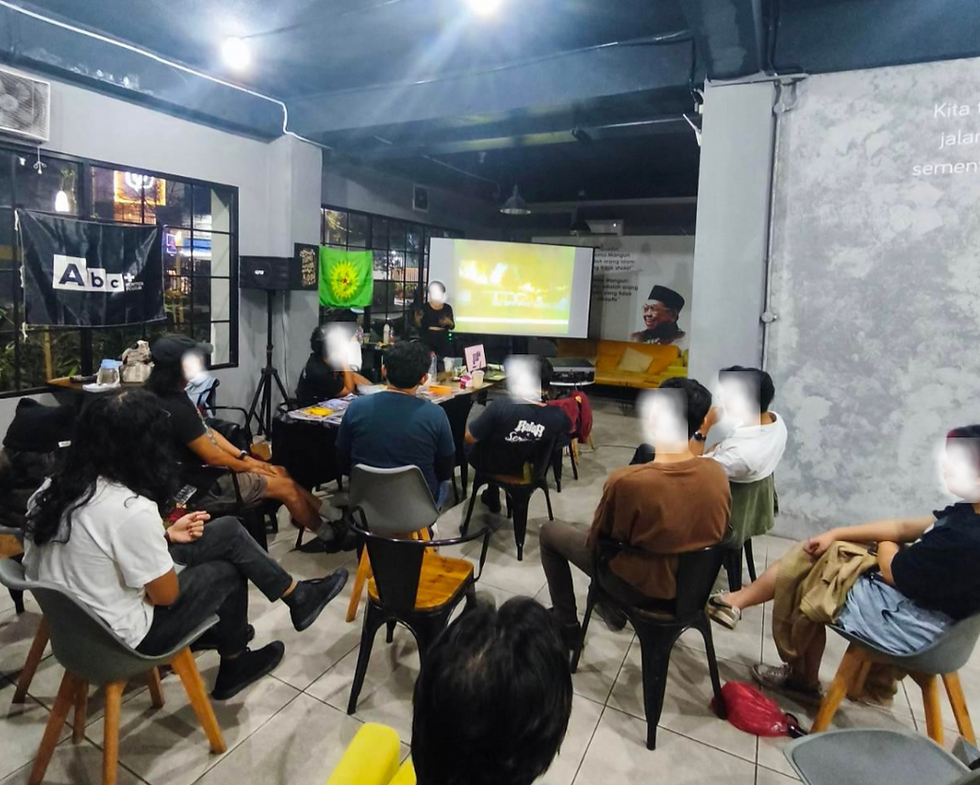
Despite the threats, groups like ABC+ continue to organise young people across the Indonesian islands and create new connections, ensuring that society does not surrender to the nation-state's oppressive ideology. They set up communal gardens, educational initiatives, and financial support systems, and make sure that their communities are safe.
All in all, it is becoming clearer that the protests were only the beginning. The organising continues, and Indonesian youth is preparing for the change of the system, which relies on domination and extraction and is not sustainable in the long term. Step by step, the movement is growing, and more people are becoming aware of the strength they have against the government’s anti-social policies.
If you want to learn more about the situation of young people in Indonesia, read our recent interview with two activists.


Comments