


“I Believe That This Is Our Time": Two Young Activists Speak A Year After Youth Protests In Indonesia
PART 2
Aleksandra Kalisz
What happens to a movement once the demonstrators disperse and the streets return to “normal”? For many young organisers in Indonesia, the months following the 2025 protests have been marked by uncertainty, reflection, and continued activism under pressure. In this interview, AK.*, a young female activist, and B.*, an organiser with ABC+ Workers' Control, discuss their experiences and share their views on last year's events and the impact they had on their communities, their organisation, and the attitudes of those around them.
1. What do you think of last year's events (protests)? How did they impact your community?
AK: It's very impactful, especially in efforts to attract more attention to the current political situation in Indonesia. Although it's unfortunate that there had to be martyrs and political prisoners for it to reach nationwide awareness. There are a lot of people in Indonesia right now who are showing remorse, especially on social media, for choosing Prabowo Subianto as president, but I don't know if electing another candidate in 2024 would have made any changes. The problems in Indonesia are deeply rooted in the excesses and residue of the dictatorship of the second president, Soeharto, whose cronies are Boomers who are still in office now and dominate the fields of enterprise and government; they control a lot of things, basically. And Prabowo has direct involvement in everything. You may have heard that Prabowo was fired from the military for his complicity in the kidnapping of 1998 activists during the Indonesian Reformation Era. He also participated in the occupation of East Timor and acted as the head of a special force team, Kopassus, which actively searched for and killed Nicolau Lobato, one of East Timor's freedom fighters. So that is definitely something to reflect on when we see the state of Indonesia right now under his regime.
I’m glad that people are starting to realise that this goes deeper than what meets the eye, but again, I’m also saddened that we have to pay such a high price for it.
B: We think this isn't all that different from the last two major waves – especially during the Reformasi Dikorupsi and the Omnibus Law protest, which also claimed more young lives (nearly a dozen) – only for it all to evaporate into thin air. What sets this apart is that the state is far more prepared than we are. Over the past decade, it has been mapping which social media networks pose a threat and have the potential to mobilise masses; that's precisely why its first move after the August protests erupted was to hunt down social media admins – and to deter civilians, it also randomly arrested people who merely reposted content, charging them with inciting unrest. Going even further, according to leaked intelligence reports that reached us through forwarded broadcast messages, it's already mapped which organisations are involved and exactly where young people gather to organise.
For us, yesterday's protests, on the one hand, showed just how courageous the youth are, with a wave far larger in scale, but they were also accompanied by a wave of demoralisation just as massive. Especially after the movement appeared to be deflated by liberal and bourgeois activists pushing a reformist “17+8”[1] discourse that doesn't represent the youth masses, who unilaterally went to meet with power elites, rendering Affan's death[2] completely meaningless.
Within our organisation – or rather, our ecosystem (the relations between networks) – this has become a crucial footing for us to begin our own reflection and self-critique. It forces us to ask, more honestly and deeply: what have we actually been doing all this time? Physically, we're relatively safe, but mentally, it's pushing us to finally analyse our own ranks within this ecosystem, which we've so often neglected while focusing solely on analysing the enemy.
2. Has your organisation changed since last year? Have you noticed other groups or people doing things differently?
AK: Yes, it has happened for a while, but people are more aware of the presence of the police and military now. Among young people, the occupation is still popular, but not so much anymore, to the point that you’ll get ridiculed on social media for being a police or military member. I can say that people are coming to realise how malicious (and stupid) they are, because aside from the case where the police ran over Affan Kurniawan last year, there are many other instances where the police and the military have been convicted of killing innocent civilians, like what happened in Maluku last month, when a personnel suddenly hit a 14-year-old boy named Arianto Tawakkal in the head with his tactical helmet for literally nothing; Arianto was just riding his motorbike.
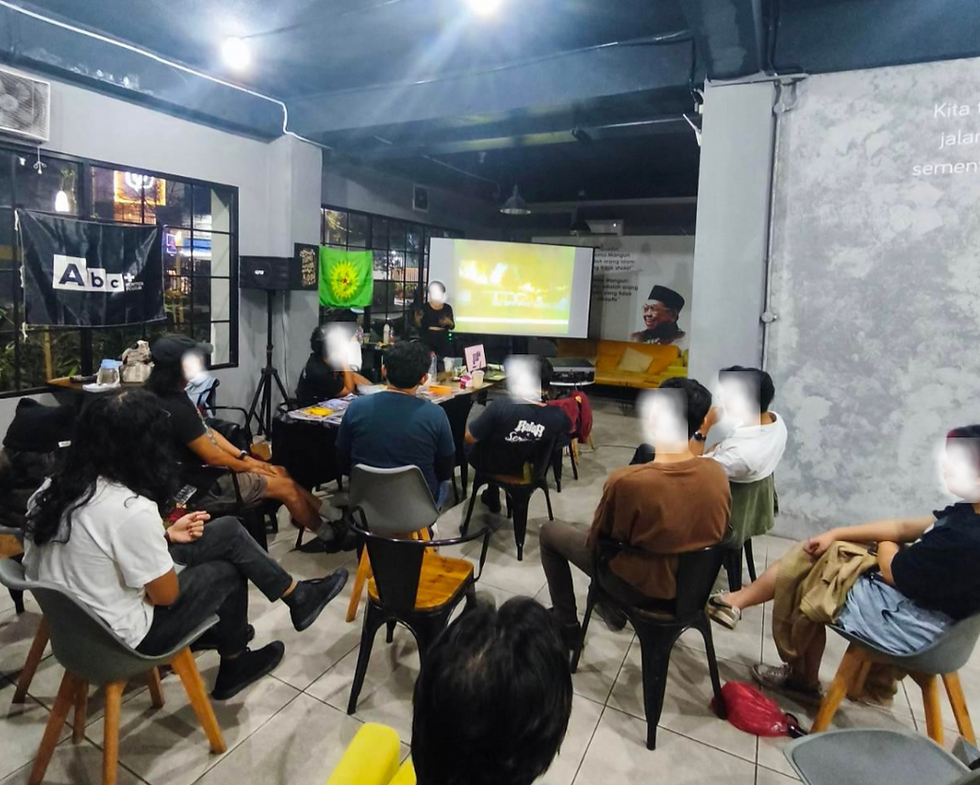
B: Our organisation (ABC+ Workers' Control) hasn't changed; we continue to focus on building networks among urban village communities and poor urban youth. What has changed is that our work agenda now centres on ideologising economic democracy and establishing a much larger solidarity economy network spanning several cities. Earlier this year, we built a commune network fostered through gatherings called ‘Saba Kampung’– neighbourhoods, mutually visiting and getting to know each other’s villages. But this remains at the stage of building closeness and ideological grounding, not yet at the practical level of establishing production units. In this regard, we may well need international solidarity in the future, particularly to set up a rice mill and a tea factory.
Other groups, of course, carry different focuses and modes of action, such as our white-collar worker comrades, who focus on reproducing political writings capable of reaching the logic of middle-class workers, and cultural youth, who are now seriously organising Javanese wayang events[3] to channel social issues through modernised stories of their homeland. Now, so many groups are growing with diverse colours and are far bolder! To me, this signals that the crisis has spread across multiple levels, where those previously hard to connect with or find are now easier to locate and are willing to collaborate in socio-cultural-political events.
3. Do you think the government is focusing more on young activists than it did before?
AK: Yes, I believe there are more than 4000 young people who have been detained since the protest last year. Young people have become the force that the status quo fears, and they are trying so hard to disperse us because if we are united, waves of protests will occur again, and eventually something will surely shift.
I also believe that the change will not come through the glory days of our parents during the Reformation Era of 1998, when they literally occupied the House of Representatives’ palace. I think our struggle is different, as we need to build alternative ways of living that do not rely on the state as a mechanism. Rather, we need to cultivate our community, our villages, our kampung, and establish a support system that is detached from the state, so that when it falls, we will not be shaken. This does not mean that I discredit the struggle of our youth who come face to face with the state, but I want to say that alongside mobilising, we also need to organise ourselves, from the smallest social circle of our family to the biggest of our society. I believe that this is our time.
B: Of course! They are analysing us even more seriously now and working to criminalise us. Our new phase is working out how we can agitate people towards progressive politics without getting tangled up in the government’s new rules, which could imprison anyone accused of extremism—or of spreading socialist ideas. Government forces – particularly the military – are starting to move back into villages under the guise of building cooperatives and distributing free, nutritious food. Territorial surveillance under this pro-militaristic government is becoming increasingly visible. Fascism is already right in front of us. The orchestrated attack against our comrade Andrie Yunus[4] is a warning sign.
We can no longer remain fragmented or be swept up in the exclusivity of sectoral issues; it has become crucial to discuss shared values such as anti-fascism and anti-authoritarianism, rather than constantly acting as if one approach is superior. We are actively working through these discussions so we don’t fall into that same mindset; that is exactly why we are pushing forward with building people’s communes.
If you want to learn more about the situation of young activists in Indonesia, read the previous article.
*names have been changed to protect the identities of the interviewees
[1] The 17+8 Demands consist of a set of seventeen short-term measures that should have been implemented within one week, and eight long-term reforms to be achieved within one year, by State institutions and parties (editor's note).
[2] Affan Kurniawan was a young Indonesian who was killed on 28 August 2025 by being run over by a police vehicle. The video of his murder further inflamed the youth protests (editor's note).
[3] The wayang is a traditional Javanese performance in which a story is represented by puppets or dancers (editor's note).
[4] Andrie Yunus is an activist with KontraS (the Commission for Missing Persons and Victims of Violence), that on 12 March 2026 was the target of an acid attack. Sources indicate that the attack was planned by a special task force linked to the Indonesian Military’s Strategic Intelligence Agency.


Comments