


The Modern Paris Commune
How the youth of Bakur rose up in defense of communal life
By Marcos Pacheco
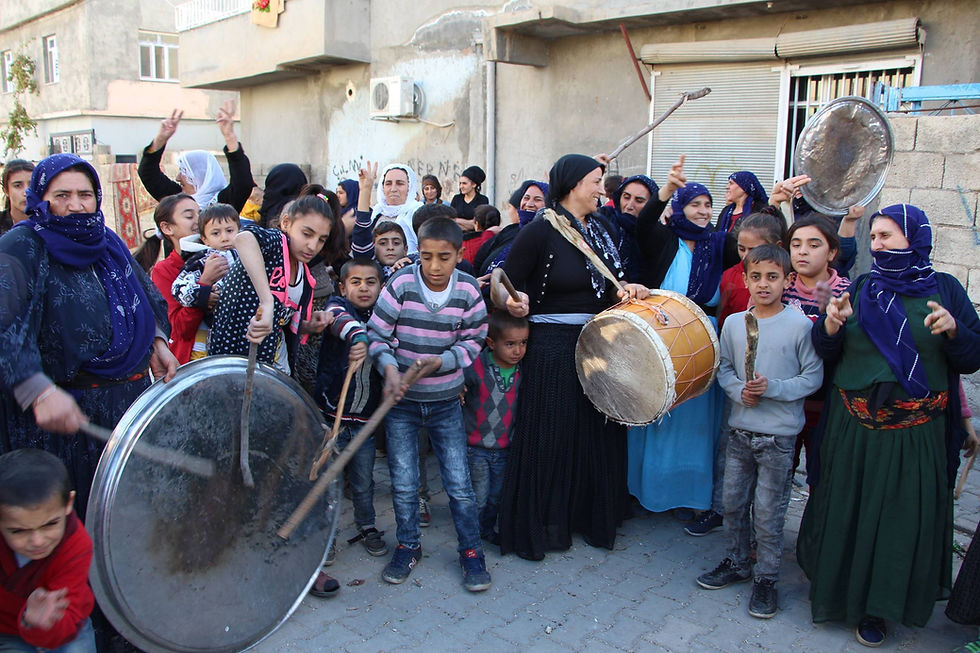
The fireworks illuminate the sky with red, green and yellow colors throughout the night. In the streets, bonfires have been lit everywhere and people of every age have congregated around them. Many of them are dancing in circles around the fires to the rhythm of the deafening music that plays through speakers. Whenever there is a pause in the music, the young people use their powerful voices to chant the songs themselves, which are in turn repeated back by everyone else.
The biggest crowd is gathered at the “Mala Gel”, the House of the People that has been recently opened. But the people of the neighborhood jokingly call it the “House of God” since, like in a mosque, it’s always full and everyone comes and goes as they want. While all the institutions of the state and of the political parties remain almost empty. Instead, people come here to solve their problems, get organized and help out. It has become the new heart of the city, where the meaning of words like politics, democracy and community is being redefined.
Even with all the noise and activity, there is not single policeman in sight. None of them would dare to come without the support of a huge military operation. Instead, groups of young people from the neighborhood, both male and female, take turns to stand guard behind the barricades they’ve been building at the main roads. Their face is hidden by patterned scarves to protect their identity, but their excitement and determination is palpable even through them. The old mothers of the neighborhood bring them food regularly and everyone else opens their house so they can sleep and rest whenever they need.
Later that same night the young people gather all together, forming a single massive column as they march through the city. As the they advance, several of the main roads are completely taken over and cut out to the traffic. They carry stones and Molotov cocktails, which they throw to any police car that dares to get close to them. More fireworks explode above their heads as an electric energy passes from body to body. In the months to come many of them will fall in battle or be taken prisoners to the inhuman prisons of the Turkish state. But tonight the streets belong to them. To the young and bold, who carry the dream of all previous generations. Tonight this is their neighborhood. Their city. Their land.
A decade on, we still hear the echoes of the struggle in Bakur
It is 15th of August, 2015 in the city of Cizre, situated at the heart of Botan, one of the Kurdish-majority regions that today is considered part of the Turkish state. Only a few days before, the people of the city, along with those of cities like Şirnexê, Amed and Nisêbîn, have announced their autonomous self-administration. This came about after years of negotiations with the Turkish state failed to reach a peaceful solution. It came to halt when the government abandoned the negotiations table and resumed its physical attacks. Although the Kurdish cities have no intention of splitting from Turkey, with this move they are declaring that they no longer recognize the authority of the state to decide their destiny for them and that they are taking control of their lives back into their own hands. This move for autonomy didn’t come from nowhere. It was the result of years of preparation and organization following a deep ideological transformation in the Kurdistan Freedom Movement.
Since the end of the 20th century, the movement has moved away from its Marxist-Leninist origins and the strategy of national liberation to adopt the strategy of Democratic Society Socialism. Inspired by the writings of Kurdish leader and political prisoner Abdullah Ocalan, it no longer seeks to “conquer the state” nor does it wait for it to grant its demands. But it’s also not trying to immediately destroy it. Instead it is focused on organizing society outside of the state, building the capacity of society to provide for itself and allowing people to make decisions about their own lives and solve problems together. They still interact with the institutions of the state, but only when doing so can widen the space for society to organize itself.
Building the communal system
In Bakur (the north part of Kurdistan that is within the Turkish border) this process started in 2009 through the establishment of councils at the neighborhood, district and city levels and with communes founded in the villages. In them, people took decisions on how life should be organised and worked together with representatives of political and civil society organizations to make these decisions. They divided their work in different committees, which took care of social, political and ideological issues, as well as others dealing with justice and diplomacy. In addition to it, many projects and organizations were created to satisfy the needs of society: workers cooperatives, artistic and educational initiatives and independent women and youth organizations among many others.
Since the liberation of women is a fundamental principle of the movement, the movement pushed and organised for women to have equal participation and decision-making power and as men, and this effort was one of the greatest successes. As part of this the system of co-presidency was implemented across every institution; this meant that every leadership position was held by a man and a woman together. Alongside this, the women’s autonomous structures gave women the space to find their own perspectives and build their own power, outside of the influence of men. This gave women great strength when participating in the mixed structures to articulate themselves and their positions collectively.
Although the heavy repression by the state made this process difficult, the results can clearly be felt as a big part of the population became politically and socially active in each other’s lives and in their communities. Whenever the police came into the neighborhood, the message spread quickly and the people mobilized to deal with them. Every time an institution is raided by the police and those responsible were arrested, the next day more people will go to re-open the institution and carry on their work. The people expected that sooner or later they would end up in prison so they organized inside to turn the prisons into into political education academies.
One of the main sources of the dynamism and energy of this process was the youth movement. They are mostly known for their role in protests and actions, but they also took the lead in the organization of activities to revive the repressed Kurdish culture, to organize themselves against the activities of drug dealers and criminal gangs in their neighborhoods and to educate themselves politically. The youth had their own autonomous councils but also participated in the general ones to push for radical change and the expansion of the revolution.
The Modern Paris Commune
In order to stifle the fierce resistance of the Kurdish youth the state sent the army to the cities, practically demolishing some neighborhoods with their bombs and tanks. In spite of this some of these youth continued to resist and were able to keep fighting for months under the incessant attacks of the state. So even though this was a setback for the self-organization of society, the examples of those like Şehîd Çiyager Hêvî, Şehîd Faraşîn Sidar and many more who fell martyr in this fight are today inspiring a new generation of young people to take up the mantle and continue their struggle.
And even though this particular phase of the struggle may have ended, what took place in North Kurdistan was an experience of people’s self-governance on a scale never seen before in the 21st century. Because although the Rojava Revolution had taken place 3 years prior, the situation in Bakur was very different. The Turkish state had not collapsed like in Syria, but still the movement was able to slowly erode its legitimacy through more than 40 years of organising and, more importantly, to was able to build a real alternative to it. It proved that this model and ideology could work in a modern context.
Just like the Kurdish movement started as a small group of young people from universities, combining their ideological deepness with the militancy of the youth, so the social struggles of the 21st century have been defined by large popular mobilizations of young people during times of social unrest. They are no longer confined to the factories, instead their main space of struggle is the public arena, the squares and the cities. But there is still the question: what next? How can we turn this temporary outbursts into long-term change?
This is where the experience in Bakur can show us a way forward. While many social movements are stuck between the need to achieve concrete gains and the difficulty of dealing with the violence of the state without compromising one’s socialist ideals and goals, the youth in Bakur were able to break this deadlock. So although they could not completely overcome every challenge they faced, their achievements demonstrate that this path can offer hope to the current generation of young people searching for a light to guide them amidst the dark in which the world has fallen. Today the struggle continues in Bakur and in every part of Kurdistan. Every sacrifice that was made forms the basis of new ideological and practical developments that spread everywhere. Just like the events of the Paris Commune opened the period of “classical” socialism that lasted until the fall of the Soviet Union, so too the “Bakur Commune” and the Rojava Revolution have inaugurated the struggle for a new socialism in the 21st century. One that is being led by the militant women and youth from all over the world and is spreading everywhere they go.


Comments